
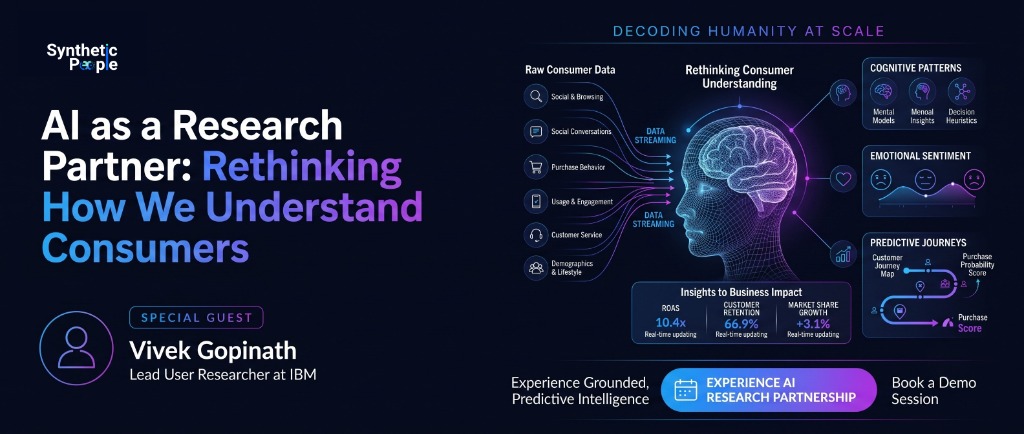
You've been exploring how AI and machine learning can support UX research. What first convinced you that AI could become a meaningful research partner rather than just another productivity tool?
It was around 2 years ago when I was actually introduced to a project that a colleague was working on. Though most of it revolved around productivity, there were certain instances — one was when I was trying to work on cyber epidemiology and in predictive UX. AI helped me to link one particular domain, i.e. medical science, with behavioural science. It helped me build the framework for a structure of causality revolving around the Rubin Causal and Bradford Hill criteria which are used in Medical Science, but with helping me with synthetic data sets and modelling, it helped me to understand whether the framework could be applicable and used in Consumer Behaviour. There were also studies where I was working on Nash Equilibrium to establish behaviour. So, AI was helping me build bridges between domains and also to help me understand where the gaps in the framework were. Personally, in most of the projects, it is helping to define structures better — and that is when I realised that it was a great idea.
Could you share an example where AI helped uncover a consumer or user insight that might have been difficult or taken much longer to discover through traditional research methods alone?
Two-three years ago, I was working on a project that was seeking to understand behavioural personas and how they existed in the ecosystem of an FMCG major brand — what were their motives, etc. At that point, I was able to use AI to help me design, filter, and also help analyse clusters. I would have missed an entire sub-persona, if that may be called, but using AI and ML I was able to identify it. That sub-persona was actually a very big pain point. I had not seen that through initially using traditional methods. But the behaviour pointed to something very interesting happening with this sub-set. If I went regularly, I would have found the clusters, but instead I asked it to do a deeper analysis and see if there were users who still didn't fit in this cluster — and then that was it. There was a particular field around re-order based personas that I would not have looked at or given much thought had I been doing regular methods. That would have been missed entirely.
AI is exceptionally good at identifying patterns, but understanding why people behave the way they do is often more nuanced. Where do you think AI adds the most value, and where does human judgement remain irreplaceable?
In my experience, AI used as a structure and framework tool is really effective — also in terms of linking things beyond what we think. For example, Matteo Paz, a high school student in the US, used AI and it helped him discover more than a million unexplored stars in the sky — a breakthrough. While perusing his methods, I discovered that his method could also be applied in behaviour studies, and that is when I think cross-linking between different domains to understand how to explain the effect is really good. Considering that there are a lot of methods and ideas in overlapping and structurally related domains, I've used this to my advantage quite a few times already — like applying the Fourier Wavelet Signals to Behavioural Patterns, understanding Signal and Noise from a cognitive perspective not just electronic theories, or the Entropy of an Interface.
Human judgement must be there as a curator and as an observer to see whether AI is taking the right path and guiding us to the correct solution. Going forward, we see ourselves being more of curators of the truth. We operate in multiple dimensions and not just the electronic medium of enquiry — where human nuances, dissonance and intuition, choices and judgements vary and change flavour with respect to context. We must see ourselves being more of curators and conductors of an orchestra where multiple information must be managed, else it all will result in cacophony.
As researchers begin using AI more frequently, do you think there's a risk of becoming overly reliant on patterns while overlooking context, emotion, and lived experiences? How can research teams strike the right balance?
I think teams are becoming overly reliant on what is fed into the AI ecosystem without proper guardrails, guiding processes, and checks. What will initially happen is that there will be a lot of teams who might get the wrong data from the AI due to rampant usage without guardrails and system checks. Context, emotion, and lived experiences are a subset of qualitative research — and I believe that it is a prudent and irreplaceable part.
A lot of the greatest discoveries in research have been about understanding the context — like the famous Betty Crocker "adding an egg to a cake" story, or how the change in product placement of a room freshener changed its fortunes. These observations are lost if we just focus on patterns. For example, I have a personal example of an observation from a user who was using a trading app. When he switched to another app, his muscle memory was designed for the other product and not the current one. It wasn't a fault of the product per se, but the mental model developed over time led to the friction in usage. Stories like these can be missed by AI — they are not recorded, not captured by data, but need to be observed.
Teams that need to strike the right balance must adhere to a set of working principles and practices of where AI must be used, at what stage human intervention is needed, and also how to protect blatant AI-generated results from those that have been vetted using guardrails and system checks for quality and audits.
Your work combines behavioural science, cognitive science, and mixed-methods research. How has AI changed the kinds of questions you're able to ask or the hypotheses you're able to explore about consumer behaviour?
In my work, the privilege of working with these interconnected domains has also compounded the complexity of the questions we seek to understand. Sometimes it is not just "why did they do it?" but also "how often?", "what is the pattern like?", "is there an underlying behaviour that governs them?" Moving beyond personas, clustering, and segmentation, I've been able to start with a deeper, narrowed hypothesis for certain cases rather than a blank canvas. So instead of looking at an entire population, my hypothesis targeted the segment based on my initial quick run using AI tools.
AI helped me identify deeper probes and how they structurally link back. So qualitatively, I have been able to ask fewer leading questions and more probe-oriented questions. Quantitatively, I have been able to look at more variables and parameters. For example, I used to use NMF to analyse behavioural personas with a limited set — now I'm able to expand the set to almost three times larger than what I had and start off with questions that lead to a stronger, narrowed and focused hypothesis closer to what the Product Managers or the Clients need.
Can you think of a time when AI pointed you toward an insight that turned out to be misleading or incomplete? What did that experience teach you about validating AI-generated findings?
This is an interesting one. I did have that during the early days — we had a set of more than 290 insights that was derived from qualitative and quantitative studies. We had a person doing the qual stuff and another with the quant. What happened was I happened to present an analysis that was built on the framework that the AI tool provided. But while processing the information repeatedly over 290 rows, it started to lose context — the inferences which were richer earlier almost started to regress to what the entire data set looked like and key findings were being left out. It ended up that the best insights were lost as they were after 200 rows of data, but by then, using the data and going through the pipeline, I ended up having insights that could have been done with n=25 rather than n=290. I had to end up reworking the pipeline and the workflows to ensure quality rather than quantity and then build for scale.
Many researchers worry that AI could make research feel more automated and less human. From your perspective, how can AI actually help researchers become more empathetic and consumer-centric?
AI revolves around human productivity and information. Research can be automated — that is a good thing — but researchers shouldn't be automated. What I mean is that processes, systems, and other day-to-day tasks can be automated, but a human in the loop is what we need. If it was a survey, AI is definitely justified in being used as an automation tool, but when we talk about empathy, it is a different ball game. Digital empathy cannot be a substitute, but what it could do is help researchers focus more on being with the users rather than having to worry about what to ask next and think about patterns and probes in the call. It can help us see evolving gaps during the conversation and help us guide unaddressed probes that are needed.
What it can be used for is like a tool that helps to focus and lead human experiences — AI must be the catalyst but we must be the ones who lead with emotion. As humans we suffer from behavioural drift and AI can help us researchers not to drift but stay in the moment and also help us with loop responses. It could help become something that helps us course correct if we drift further from the truth.
Consumer understanding increasingly depends on making sense of massive volumes of behavioural data. Which parts of the research process do you believe AI should own, and which parts should always remain deeply human?
As mentioned earlier, we as humans would not be able to process the volume of information AI does, but we can definitely become curators and the guards of the entire process. One of the most important aspects is the designing of the research itself — that should be a process that remains human, as that sets up the context and enquiry. AI should be used to build the pipelines for the framework of research, and we must be the ones to monitor and conduct it.
I would not have allowed AI to conduct interviews where probing is required, but may use it where there are no probes required. Setting up the guardrails, understanding how the information is emerging, the methods, the quality, the nuances of when to stop or whether we are even talking to the right person — those are sets of decisions that a human must make. We must consider ourselves as architects of information design and research design. The better a job we do with the architecture and how much that stays with us, the better we should be — while whatever can flow through the pipelines like processing and codes should remain with AI.
Looking ahead, how do you see the relationship between researchers and AI evolving over the next five years? What new skills do you think consumer researchers will need to stay relevant?
As consumer researchers, I wouldn't call it a skill per se, but it's about how to architect a research and design the nature of the research — that will be more important. One would be expected to know deeper into their own fields of research. We would be expected to have an all-round knowledge of how things work: a bit of coding (to be able to read code and understand what has been generated), a bit of mathematics and stats, psychology, cognitive science, and behavioural science. It's more like a conductor of an orchestra — you need to know how all of them sound and when to use what, but not necessarily become a master of them all.
As AI evolves over the next years, automation and even some basic research might be taken up — and for us, that job might be irrelevant. We would be required to partake more in product strategy and work with predictive consumer behaviour. A good example would be the story of how Target could understand consumer patterns to know which of their consumers would be or are likely to be pregnant and hence suggest them the right products. Consumer Product Strategy and Predictive Consumer Behaviour — these are the ones that young researchers and we ourselves must focus on.
If you were mentoring a young researcher who's excited about AI/UX research but doesn't want to lose sight of understanding real people, what advice would you give them?
To a young researcher I might say that as interesting as AI/ML in UX Research is, it is probably best to understand the fundamentals that make it up. Understand Psychology, Cognitive Science, Behavioural Science. Learn the art of interviewing — not everyone is good at it. Great interviewers have a mix of soft skills, persuasion, and an excellent way to probe questions. So it is always best to talk to people and discover things. Then the mystery of solving whether what they said is true — were they lying? Do their words match what they do or consume? Understanding human behaviour is probably the most intriguing thing to do.
AI can help accelerate the journey, build frameworks to analyse, help us build work pipelines for automation. I've always believed that we are digital doctors — some treat interfaces, some understand behaviour in a digital sense, and some test the behaviour at scale like epidemiologists. So focus on the basics of what makes Design, Psychology, Behavioural Science — and sprinkle with a little statistics so that you know how to conduct the orchestra of UX.