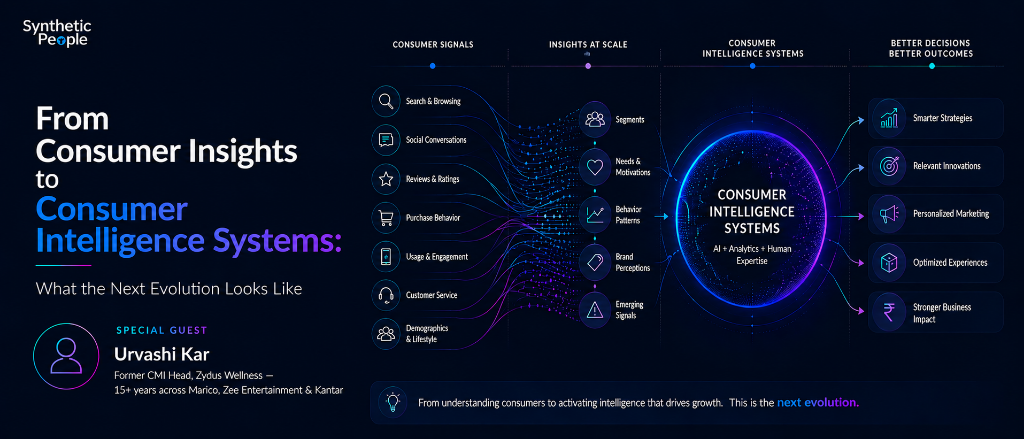
Over the past 15 years, how have you seen the role of consumer insights evolve within organizations, and what do you think is driving the shift toward consumer intelligence?
When I started out, insights teams were largely seen as a support function — you'd commission a study, deliver a report, and hope someone read it. The role was reactive and episodic. What I've witnessed over the past 15 years is a fundamental repositioning of insights from a project delivery function to a strategic advisory function.
The shift toward consumer intelligence — as opposed to just consumer research — is being driven by a few converging forces.
First, the explosion of data sources. We now have behavioral data, social listening, CRM data, and passive tracking sitting alongside traditional survey and qualitative work.
Second, the competitive environment has intensified to the point where organizations can no longer afford to make decisions based on annual trackers and quarterly deep dives. They need always-on understanding.
Third, and perhaps most importantly, there's been a leadership-level recognition that understanding the human behind the data is a genuine source of competitive advantage. The best organizations have stopped asking "what do consumers say?" and started asking "what do consumers mean, and what does that mean for our strategy?"
Many companies have more consumer data than ever before, yet decision-making often remains slow. What do you think is missing?
Raw data doesn't make decisions; human judgment applied to synthesized, contextualized intelligence does. Most organizations are drowning in information but starving for meaning. What's missing is Synthesis.
There's also a structural problem: insights are often produced in silos — CX data here, market research there, social analytics somewhere else — with no connective tissue drawing them into a coherent narrative.
What distinguishes a truly decision-centric intelligence system from a traditional consumer research function?
A decision-centric intelligence system is demand-driven — it is organized entirely around the decisions the business needs to make, at the speed those decisions need to be made.
First, they are embedded in planning cycles, not invited in post-hoc.
Second, integration of multiple data streams. Rather than owning one methodology, a decision-centric function synthesizes qual, quant, behavioral, and market data into a unified intelligence view.
Third, forward orientation. Traditional research tends to describe what has happened or what consumers currently feel. Decision-centric intelligence is constantly asking: what does this mean for where we need to go?
Having worked extensively across qualitative and quantitative research, where do you see the greatest opportunity for AI to strengthen consumer understanding rather than simply automate existing processes?
The truly transformative opportunity lies in pattern recognition at scale with human interpretation at the center. AI can surface signals across thousands of data points that a human analyst would take weeks to identify.
The opportunity is to use AI to expand the aperture of consumer understanding, to see more of the terrain, and then bring human qualitative expertise to bear in making sense of what those patterns actually mean. AI can tell you that a behavior has changed; a skilled qualitative researcher can tell you why, and more importantly, what it signals about evolving human needs. That combination — machine breadth, human depth — is where real understanding lives.
How can organizations ensure that speed does not come at the cost of context, nuance, and human understanding?
Speed and depth are often presented as opposites, but I don't think they have to be. The key is building what I describe as a tiered intelligence architecture — where rapid, lightweight methods feed into, rather than replace, deeper contextual understanding. Speed comes from preparation and infrastructure, not from cutting corners on depth.
Organizations also need to resist the cultural pressure to reward velocity over accuracy. There is a tendency in fast-moving businesses to value the insight that arrives in 48 hours over the insight that takes two weeks but is fundamentally more correct.
In your experience, what are the biggest barriers preventing consumer insights from influencing strategic business decisions at the highest levels?
First is credibility and framing. Insights teams often speak in the language of methodology while senior stakeholders speak in the language of commercial consequence. Until insights are translated into business impact, there will be a struggle to command boardroom attention.
Second is timing. Even excellent research delivered after a decision has been made is commercially useless. Insights functions that are not embedded in strategic planning cycles will always be playing catch-up.
Third is organisational culture. In many companies, there is an implicit hierarchy of evidence in which financial data and operational metrics are treated as objective truth, while consumer research is treated as soft, subjective, or anecdotal.
How should organizations combine AI, analytics, behavioural science, and human expertise to create a more complete picture of consumers?
I think of this as building a multi-lens intelligence model, where each discipline contributes something the others cannot. The mistake many organizations make is treating these as competing approaches rather than complementary ones. The future of consumer understanding is not AI versus human researchers, nor behavioral science versus traditional survey work. It is the deliberate integration of all four lenses into a coherent intelligence practice, governed by a clear logic of when each is most valuable.
How can insight teams move beyond reporting consumer behaviour to helping organizations anticipate future consumer needs and market shifts?
Moving from descriptive to anticipatory intelligence requires a fundamental shift in the questions insight teams are trained to ask. This means investing in cultural and societal listening — tracking not just category behavior but the broader forces shaping human values, identity, and aspiration.
It means using qualitative methods not just to understand current experience but to explore latent needs — the things consumers cannot yet articulate because the solutions don't yet exist. It means working with futures methodologies, scenario planning, and trend synthesis alongside traditional research.
Can you share an example of a time when consumer intelligence challenged an established assumption, and what factors helped senior stakeholders trust the insights and act on them?
I remember a project that involved a well-established consumer brand that had long operated on the assumption that its consumer segments were defined by regions more than any other demographic factor. The entire portfolio strategy, communication approach, and channel investment was built around that assumption.
Through a combination of qualitative depth work and behavioral data analysis, we identified that the consumer segments get more sharply defined by the age and gender, that directly contradicted the dominant narrative.
What made leadership act on this insight was not the data alone. It was a combination of factors: first, the qualitative work gave the data a human face — leadership heard directly from these consumers in their own words, which created emotional resonance that a slide of statistics couldn't replicate. Second, we connected the insight to a concrete commercial opportunity, with sizing and a clear strategic implication. Third, we had built sufficient trust with the senior team over time that they were willing to sit with a finding that challenged their world view rather than immediately dismissing it. That trust, accumulated over multiple previous engagements where our work had proved accurate, was ultimately the deciding factor.
Looking ahead five years, what do you believe the most effective consumer intelligence organizations will do differently from today's leading insight teams?
Firstly, they will have moved from project-based to continuous intelligence — maintaining a persistent, always-on understanding of consumers that updates in near real-time and is accessible across the business, not locked inside a research team.
Secondly, they will have fully integrated human and artificial intelligence — not as an experiment or a cost-saving measure, but as a deliberate design principle. AI will handle scale, speed, and pattern detection; human researchers will handle depth, interpretation, and ethical judgment.
Thirdly, the best teams will be anticipatory by design — their core mandate will be not be limited to understanding the present but to find opportunities for the future. They will help organizations stay ahead of consumer evolution rather than perpetually catching up to it.
Fourthly, these teams will have strategic authority — not as a service provider but as a core intelligence function shaping the direction of the business.
The distance between where most insight functions are today and where the best will be in five years is not primarily a technology gap. It is a mindset and capability gap — and closing it requires investment in people, culture, and the willingness to fundamentally reimagine what consumer intelligence is for.
Closing Thought
The distance between where most insight functions are today and where the best will be in five years is not primarily a technology gap. It is a mindset and capability gap — and closing it requires investment in people, culture, and the willingness to fundamentally reimagine what consumer intelligence is for.