
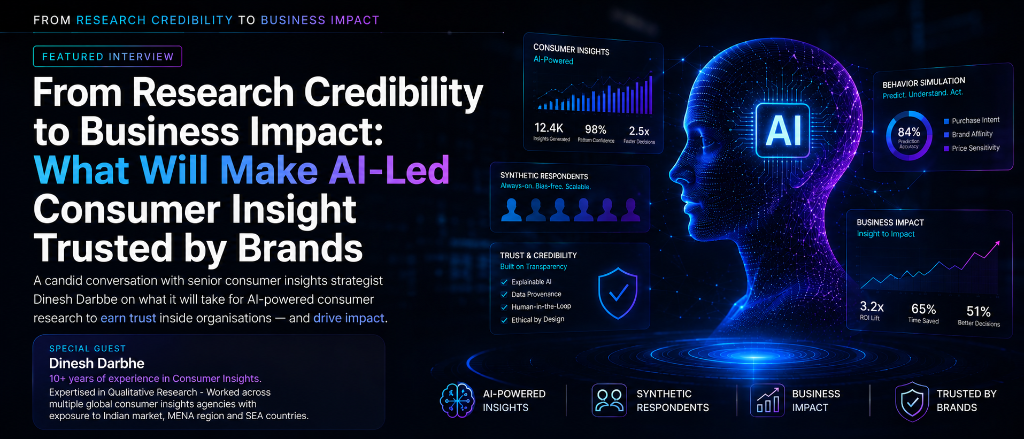
After more than a decade in consumer insights, what is the single biggest factor that determines whether stakeholders trust the research finding enough to act on it?
Most often, action on insights is taken basis three important factors:
- If the insights are based on consumer truths
- If the insights are actionable to company’s feasibilities/ capabilities/ timelines
- If the vision of the product/ service is aligned with the insight
What are the biggest concerns that insights professionals have today about AI-generated consumer understanding?
While there have been lot of concerns about AI generated consumer insights could be hallucinated and not consumer truths, those concerns do seem to be fading fast. However, even with AI analysis, insight professional still need to ensure the insights are grounded on consumer realities and not hallucinated.
Consumer insights are based on current consumer realities – While AI-led generated insights are 'Historical' data-based realities (from past studies, past data). Bridging that gap along with ensuring the regional nuances/ realities is a job that a consumer truth is more capable compared to AI led insighting.
In your view, what would an AI-led consumer insight platform need to prove before a research team could consider it a credible source of consumer understanding?
AI-led consumer insighting certainly needs to draw parallels with consumer truths – A comparative learning on the difference between AI-led insighting and consumer insighting might help understanding the realities and possibly accept the AI-led insighting to an extent.
How important is transparency in AI-generated insights? Should teams be able to understand how an insight was derived before they can trust it?
Transparency has always been the core of consumer insights. From showcasing real consumer verbatim to support an insight to actually meeting the consumers to understand their perspectives. Richness of consumer insights comes from that level of transparency.
Hence, for AI-generated insights to possibly have an edge and to help insight professionals to buy into it, transparency should certainly be fronting the sales pitch.
What role do validation and benchmarking against real-world studies play in making AI-generated insights acceptable inside organizations?
Validation of AI-generated insights should start from transparency. With that, validation in the initial stages could help boost the acceptability of it.
Benchamarking of AI-generated insights to actual consumer truths could be an uphill task in terms of investments in the initial stages. However, if proved, could become a game changer.
Many organizations struggle not with generating insights but with generating confidence. How can AI help increase decision confidence rather than simply produce more information?
Typically, organizations face multiple challenges to take action on the insights due to multiple factors like:
- Brand Market realities don't match with insights – Sales & Marketing teams know a different reality internally from the numbers than what the consumers have actually said. Hence, organizations have to take a tough call between taking the decision basis consumer truth or the truth the internal numbers say
- Budget constraints – No need to explain this further
- Functional issues – Could be Target Group related, could be product life stage, could be feasibility issues
If the actual challenges of actioning the insights within the organizations are understood (including the emotional, functional and budget constraints), an AI led 'way-forward' could surely help in building confidence to action the insights
Which consumer research use cases are most ready for AI-led approaches today, and why?
Upstream and downstream ad evaluations are most ready for AI-led approaches today. This is most standardized research activity in the industry and low on investments. The evaluation parameters are highly standardized and speed is most critical in the industry. Organizations could be most likely to take the risk more on this aspect of the research considering the need for speed.
Where do you believe human-led research will continue to play an indispensable role, even as AI capabilities become increasingly advanced?
Exploratory research – Where consumer’s future truths are derived from the current consumer realities as humans understand humans better through emotional, empathetic and social lens.
What will it take for senior marketers, innovation leaders, and business heads, not just researchers to trust AI-powered consumer insight?
I believe the acceptance of AI’s role and impact has have already seeped into most departments and most levels within organizations.
However, the use-cases and the fact of actionabilities generated through AI is based on realities is something that needs to be hand-held to key stakeholders to start relying on decision making which are AI-led insights.
If you had to define one benchmark that would convince the industry that AI-led consumer research has earned its place, what would that benchmark be?
Predictability capabilities that is comparable to consumer-based insights should help enhance acceptability of AI-led insights. However, if started small (from ad evaluations) and proven with minimal differences, that could be a good starting point.