
Over your 15+ years in consumer insights, how have you seen the function evolve from a research support role into a more strategic decision-making capability within organizations?
Generally, a consumer insights function primarily operates as a business support function that is used to validate a hypothesis or a possible business decision. Over the years, this dynamic has shifted with growing availability of & access to data. Even within businesses, we have seen a shift away from using historical precedence & intuition to make decisions, towards treating every business challenge as a unique, highly nuanced problem that requires a bespoke solution.
In this context, the Insights function has also been evolving from a support function to a core function. It is no longer just about only ensuring that the organization has the right data at the right time; it is also about synthesizing adhoc consumer data into real-time strategies. Today, insights functions are no longer just supporting the corporate strategy, they are actively shaping it.
When you think about a true “consumer intelligence system,” what makes it fundamentally different from a traditional consumer insights function?
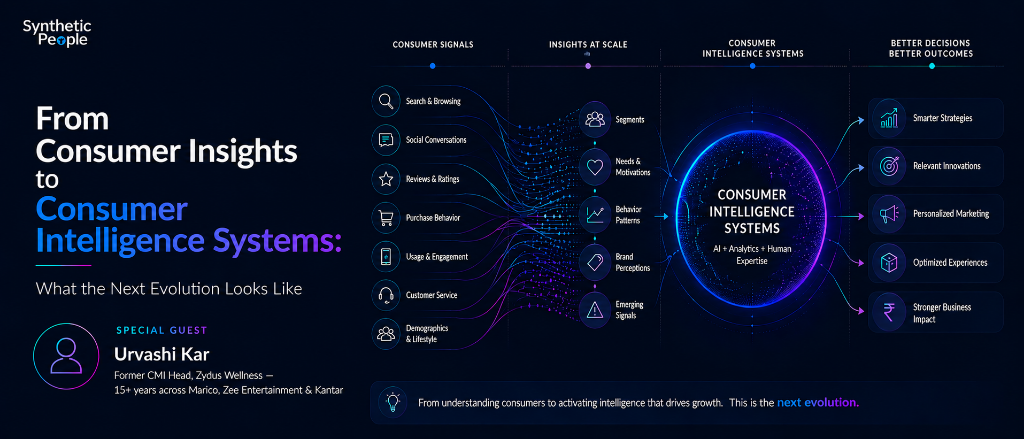
The fundamental difference between a traditional consumer insights function & a consumer intelligence function lies in a shift from a reactive, project based model to a proactive, continuous ecosystem.
Traditional consumer insights functions work on a request-and-respond basis. A business problem emerges, a research project is commissioned, data is isolated, and an answer is delivered to address that specific issue. By the time the data is collected, cleaned, and synthesized, the window of opportunity has often passed.
A consumer intelligence system replaces isolated data points with a continuous, live data system. It operates as an always-on data layer—seamlessly aggregating, structuring, and analyzing multiple data points, in real time.
This changes the conversation from diagnostic to predictive. It acts as an early-warning system, giving leadership a chance to understand emerging cultural trends, catch competitive shifts, and identify unmet needs long before they surface as business problems.
What types of inputs: research, behavioural data, analytics, digital listening, and cultural context- need to come together for consumer intelligence systems to be genuinely effective?
The short answer is - everything. If a data point is even remotely connected to the consumer, it belongs in the mix.
However, the real advantage for an organisation doesn’t just come from collecting massive amounts of data. It comes from ensuring the data converges. Many organizations concentrate their efforts in building up large volumes of data in silos. The data points often don’t talk to each other. A consumer intelligence system solves for this problem.
In your experience, what prevents organizations from connecting these inputs into one integrated intelligence ecosystem today?
In my experience, it is never a lack of intent. Most leaders intuitively understand that a single view of the consumer is the holy grail of business. The hurdle is execution. When organizations want to transition from fragmented insights to an integrated intelligence ecosystem, they usually hit three barriers:
- Infrastructure & Capex – Most organisations struggle to get to a financial commitment for the capex. And therefore, they try to build piecemeal on top of the existing old infrastructure and struggle to make both talk to each other.
- Legacy treatment - In many organizations, consumer insights are still seen as a passive cost centre rather than an active growth engine and is deprioritised for in budget allocation, which usually goes towards profit centres.
- The expertise gap – There is a shortage of talented professionals who possess both technical expertise to navigate data environments and business acumen to get strategic & actionable results out of it.
How can consumer intelligence systems move beyond reporting trends to actively shaping brand, product, and growth decisions earlier in the process?
In my opinion, consumer intelligence systems have already moved beyond reporting trends to actually shaping brand, product & growth decisions. The real question is about speed – how fast they can do it. The challenge for organisations now is to keep closing the time gap to achieve real time synchronisation between data & action. To reach this optimum, a fundamental mind shift is required within organisations to challenge culture & operations. Some of changes required are
- Aligning data & reporting cycles – consumer & market data moves by the minute, but most reporting & review cycles are monthly or quarterly. Which means that the data remains unutilised & unproductive in the time in between.
- Minimising the decision hierarchy – Access to real time data is meaningless, if the insights have to move up a hierarchy and the decision or action needs to move down it. These hierarchies need to be broken down so that insights & action can occur as close to real time as possible.
As organizations adopt more AI and automation, how do you ensure consumer intelligence remains rooted in human behaviour and emotional nuance?
At the end of the day, the root of all the data that flows into the consumer intelligence system comes from consumers. AI hasn't changed what drives consumer desires, anxieties, or motivations; it has simply enhanced the ability to extract, process, and scale those behavioural indicators. Hence, in the drive to include AI & automation, it becomes supremely important to safeguard consumer emotional nuances by
- Ensuring Human-in-the-loop (HITL) protocol – Treat AI as a means to augment human researchers rather than their replacement. Use AI & automation to free up teams to be more focussed towards human emotions.
- Retain best practices of regular consumer immersions – to keep businesses close to ground realities. So that both Big Data and Thick Data (human-centric "why" that can only be captured through direct human observation) can be synergized effectively.
Where do you see AI strengthening consumer intelligence systems the most today and where do you believe human judgment will remain indispensable?
I don’t see different roles AI & human judgment. They must perform the same roles together.
AI will need to perform while being human led & human monitored through the HILT protocol.
AI is designed to always come up with answers, solutions & predictions that are based on data, logic & patterns. It cannot account for human emotions, feelings & intuition which may go against a logical answer or prediction.
For example, in a restaurant, AI may make the best choice for a meal for a consumer, based on prices, sizes, consumer ratings, availability, time of meal etc. But it can never account for human cravings which are unexplained & often illogical. Hence, the best choice for a meal arrived at by AI & a human in the same situation will vary greatly.
Human judgement will always be indispensable is all situations. AI can only help humans evaluate and reach decisions more efficiently.
As leadership teams become more ROI-focused, how should insights leaders demonstrate the business value of consumer intelligence systems?
To demonstrate business value of consumer intelligence systems, insights leaders need to change the conversation from soft metrics into hard CFO metrics. They need to change the conversation on two pillars – Efficiency & Accuracy.
- Efficiency – A consumer intelligence system reorganises the cost structure along 3 vectors
- Reduction of decision time - Legacy systems operate with a delay, resulting in organizations reacting to market realities that have already shifted. A CIS closes this gap, moving the business toward real-time visibility. In a dynamic market, an operational lag can have large financial consequences
- Marginal Cost implications – Ad-hoc research requires replicating the entire data life cycle, every time a new business question emerges. A CIS completely transforms this. Once set up, the costs of arriving at strategic insights are only marginal.
- Scale – Legacy setups cannot manage the scale of data that a CIS can, thus ensuring no data point or insight is ever missed and the organisation is not blindsided
- Accuracy – Leadership teams do not only need fast answers, they also need highly precise answers. A CIS enables highly accurate strategic directions that mitigate organisational risk.
Looking ahead three to five years, what new capabilities will define the strongest consumer intelligence teams and what should leaders start building now?
In the next 3-5 years, CIS team will not be formed by pure technologists or pure social scientists. It will be led by professionals who operate at the intersection of left-brain algorithmic prowess and right-brain emotional literacy.
This will require a radical change in capability building. Starting with the pedagogy of students who want a career in field. Those already on their career path will need to re-evaluate their skills and build skills where they lack. Those in more technology forward roles will need to build on skills of deep consumer understanding & empathy. While those in consumer centric roles will need to include tech skills into their skill sets.