
You’ve built and scaled insight functions across agencies, media networks, and enterprise ecosystems. Looking back, where do you think the traditional “insight factory” model breaks down most severely today - speed, relevance, influence, or something deeper in how organisations operationalise understanding itself?
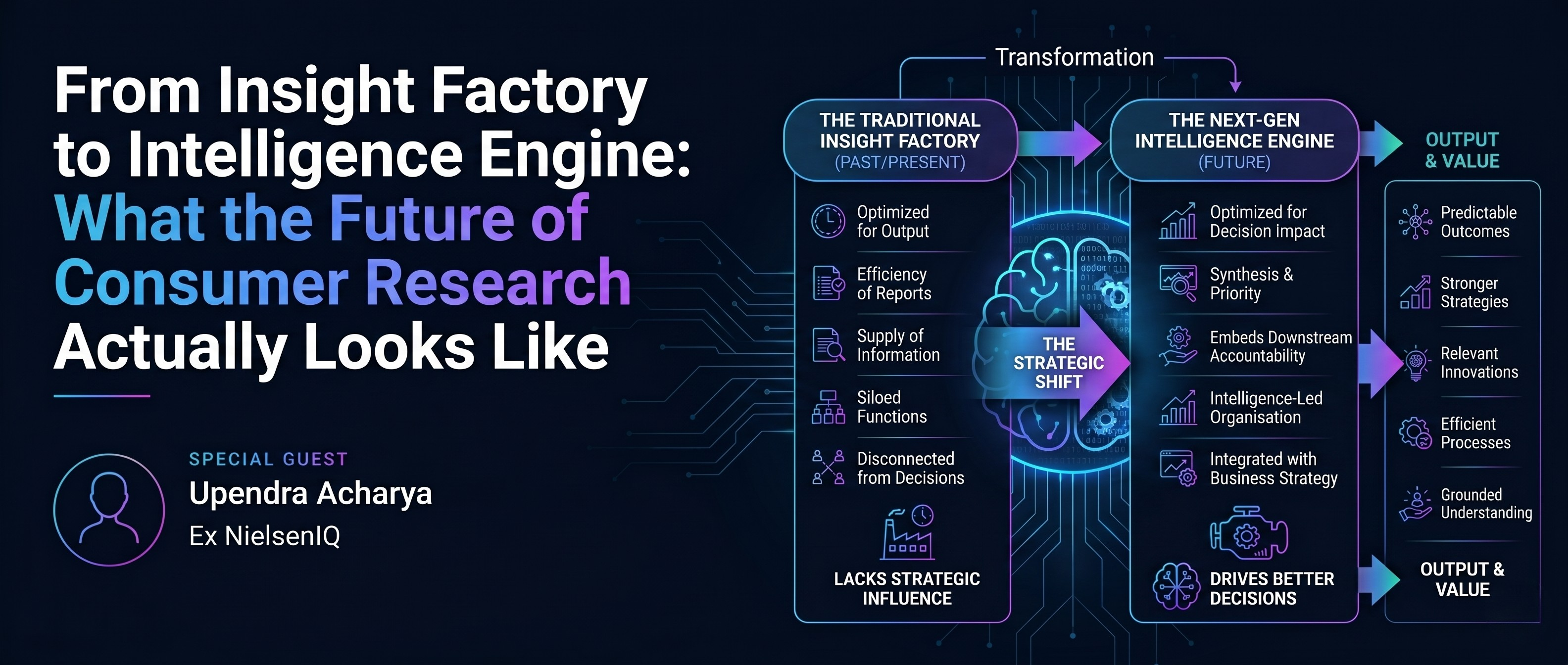
The biggest breakdown today is not speed or even relevance, it is influence. Most “insight factories” are still optimised for output, not decision impact. They generate reports efficiently but remain disconnected from how businesses actually make decisions. The deeper issue is that insight functions are often positioned as suppliers of information rather than partners in shaping strategy. Until insights are embedded upstream in problem framing and downstream in decision accountability, the model will continue to underdeliver.
You’ve spoken about the dangers of mistaking synthetic outputs and digital signals for real consumer truth. In your view, where should organisations draw the line between AI-led exploration and human-led validation? What decisions should never rely purely on synthetic intelligence?
AI is extremely powerful for exploration, pattern detection, hypothesis generation, and scenario testing, but validation must remain human-led, especially where decisions involve emotion, context, and real-world trade-offs. Decisions that should never rely purely on synthetic intelligence include brand positioning, creative strategy, cultural interpretation, and any choice that shapes long-term consumer trust. These require grounding in real human behaviour, not just modelled patterns.
Many organisations today have access to more dashboards, trackers, and signals than ever before, yet decision confidence often feels weaker. Why do you think more data has not necessarily translated into better consumer understanding?
More data has not improved confidence because organisations have scaled signals without improving interpretation. Data abundance has created noise, fragmentation, and conflicting narratives rather than clarity. The gap is not in data availability but in synthesis and prioritisation. Without clear problem framing and a disciplined approach to connecting insights to decisions, more data simply increases ambiguity rather than resolving it.
You’ve led insight systems that combine primary research, social listening, retail intelligence, and AI-assisted workflows. What does a genuinely “intelligence-led organisation” look like to you compared to a company that is simply using more research tools?
An intelligence-led organisation is defined by how decisions are made, not by how much data it uses. It integrates insights across functions, aligns them to strategic priorities, and embeds them into everyday decision-making. In contrast, tool-heavy organisations accumulate dashboards and research outputs, but insights remain siloed and reactive. The difference lies in integration, accountability, and the ability to translate understanding into consistent business action.
One of the strongest arguments for synthetic consumer systems is their ability to rapidly test hypotheses, messaging, edge cases, and scenarios before investing in expensive fieldwork. In your view, where do you see the highest strategic value for synthetic audiences inside the research workflow?
The highest value of synthetic audiences is in early-stage exploration - rapid hypothesis testing, message iteration, and identifying edge-case scenarios before investing in time and cost-intensive research. They are particularly effective in narrowing down what to test in the real world, rather than replacing primary research. Their strength lies in direction setting, not final validation.
You’ve highlighted that synthetic systems can create false confidence when outputs appear precise but are built on weak assumptions. What safeguards, validation layers, or transparency standards do you believe responsible AI-driven insight systems must adopt to earn long-term trust?
Responsible systems need three layers: transparency, triangulation, and traceability. Transparency in how outputs are generated, triangulation with real-world data sources, and traceability of assumptions behind every model. Without these, synthetic precision can create false confidence. Long-term trust comes from acknowledging uncertainty, not masking it with overly definitive outputs.
Research teams have traditionally been evaluated on reporting, tracking, and delivering studies. As AI automates more operational work, how do you think the role, structure, and talent profile of future consumer insight teams will evolve?
In my opinion, insight teams will shift from execution-heavy roles to strategic problem-solving roles. Routine tasks like reporting and tracking will be automated, while human effort will move towards synthesis, interpretation, and influencing decisions. The future talent profile will combine analytical thinking, business understanding, storytelling, and the ability to work alongside AI systems rather than compete with them.
A growing tension today is between “faster insights” and “deeper understanding.” In your experience, what are the signs that an organisation is moving too fast with consumer intelligence without grounding itself in real human context?
The clearest sign is when decisions are made faster, but outcomes become less predictable. Other indicators include over-reliance on dashboards, declining field interaction, and narratives that feel data-driven but lack real human depth. When organisations stop validating insights through real consumer interaction, they risk mistaking speed for understanding.
Synthetic consumer platforms often claim they can uncover emotional drivers, hesitation, contradictions, and unspoken behaviour earlier than traditional methods. From your perspective, what would make such systems genuinely credible rather than simply convincing?
Credibility comes from alignment with real-world behaviour, not just internal consistency. Systems must demonstrate that their outputs can predict or match actual consumer responses over time. Beyond that, they need to expose assumptions, show where they may fail, and integrate seamlessly with real data. Convincing answers are easy to generate; credible systems are those that remain accurate under real-world testing.
If you were advising a CMO or CEO building the next-generation consumer intelligence stack today, what balance would you recommend between AI systems, synthetic simulations, behavioural science, and real-world human research?
The optimal balance is layered rather than either/or. AI and synthetic systems for speed and exploration, behavioural science for interpreting decision drivers, and real-world research for validation and grounding. If I were advising a CMO, I would recommend using AI to frame possibilities, but reserving final decision confidence for insights that are validated through real human interaction and behavioural evidence.