
Businesses often walk into a meeting asking, "What does the data tell us?" In your experience, is there a more important question leaders should ask before they even look at the data? Why does starting with the right question lead to better business decisions?
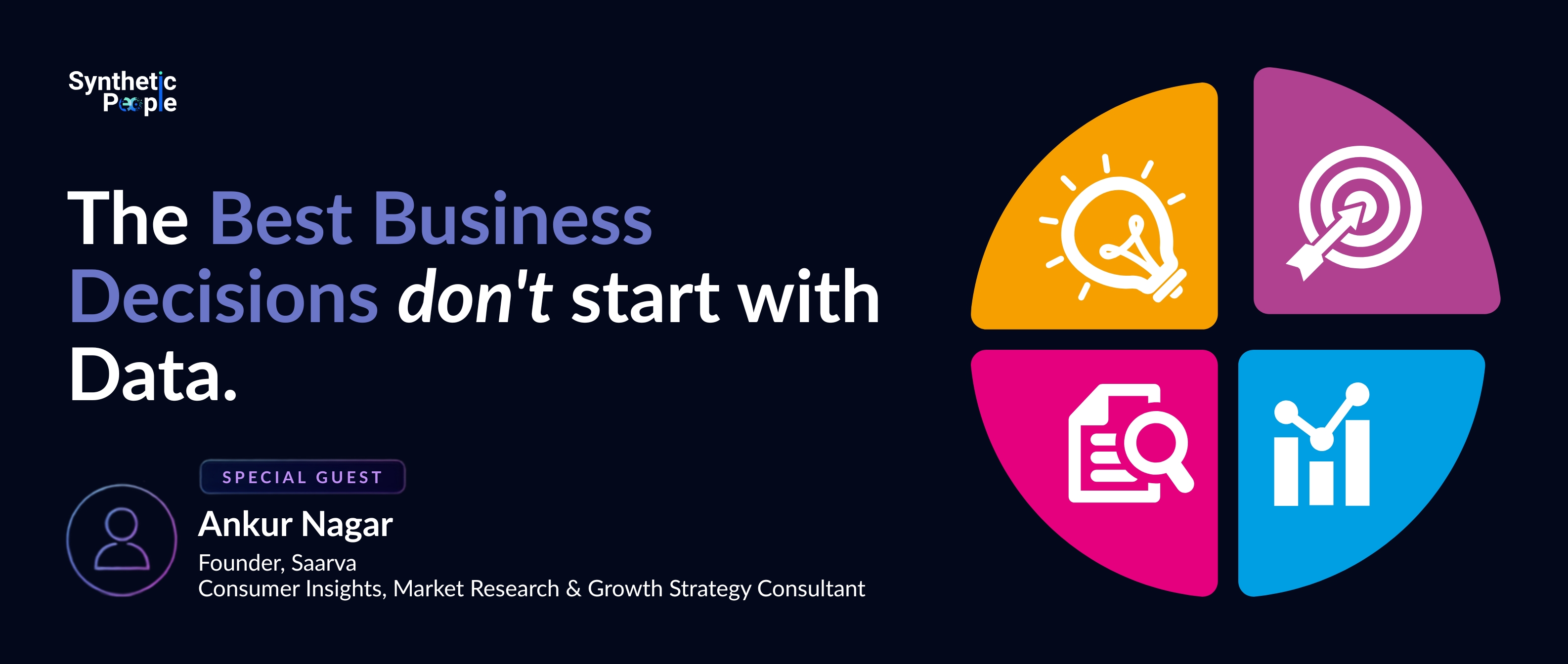
If there is one question I have learned to ask before looking at any data, it is this: "What decision are we trying to make?" Over the past two decades, I have worked with organizations across FMCG, financial services, telecom, automotive and startups, and one pattern has remained remarkably consistent. Businesses rarely struggle because they lack data. They struggle because they begin with a research question instead of a business question. The objective is not to collect more information; it is to reduce uncertainty around an important decision.
I've seen projects begin with broad briefs like "Help us understand our consumers," when the real need was to decide whether to launch a product, reposition a brand, improve customer experience, or enter a new market. Once that decision is clearly articulated, the entire approach changes. The questions become sharper, the evidence becomes more relevant, and the insights become actionable rather than merely interesting. At Saarva, we often remind ourselves that consumer understanding is not the destination—better business decisions are.
Data informs decisions. The right questions shape them.
Have you ever worked with a business that was trying to solve the wrong problem altogether? Without naming, could you share how reframing the question completely changed the decision or outcome, and what that experience taught you?
One experience that really stuck with me from early on in my consulting days completely shifted my approach to tackling business issues. I had a client who was dead set on revamping their brand architecture, convinced that customers were getting mixed signals from their product lineup. They were already talking about sinking a lot of money into it and were looking at different ways to make it happen.
Instead of testing alternative brand structures, we paused and asked a simpler question: "Are we certain this is the problem consumers are experiencing?" Through immersive consumer interactions and collaborative workshops, we discovered that consumers weren't confused by the brand architecture at all. Their challenge was navigating the category itself. The business had been solving an internal branding problem while consumers were struggling with a completely different buying journey. That insight shifted the focus from reorganizing brands to simplifying communication and improving the customer experience—an outcome that delivered far greater business value.
That project taught me an enduring lesson. Clients often arrive with a research question. Our responsibility is to uncover the business question hiding beneath it.
Insight begins where assumptions end.
Every organization has data, but only a few consistently turn it into better decisions. In your experience, what separates organizations that learn from consumers from those that merely collect consumer data?
What sets successful organizations apart is not the amount of consumer data they collect, but rather how they use it to drive their business decisions. They take the time to really think about what the data is telling them and how it can inform their strategy. For them, understanding their consumers is not just a one-time research project, but an ongoing process that guides every important decision they make. In other words, they see consumer understanding as a key capability that helps them stay ahead of the game, rather than just a box to check off in a project plan. By doing so, they are able to make more informed decisions that lead to better outcomes for their business.
I've worked with companies from all sorts of industries, and the ones that always seem to do better than the rest have one thing in common. Instead of asking "what are consumers saying?", they ask "how will this impact the decisions we're about to make?". This small change in approach completely flips the conversation - it's no longer just about sharing findings, but about using that information to inform strategy. It gets people talking, makes them question their assumptions, and pushes leaders to think about how what consumers want will affect their business results. By doing this, companies can make more informed decisions and stay ahead of the game.
Consumer insights create value only when they influence decisions. Otherwise, they remain well-presented information sitting in a report that nobody revisits.
Insight creates value only when it changes a decision.
Many businesses ask consumers what they want. But is that always the right question? Can you share a situation where looking beyond the obvious uncovered a much bigger insight and eventually led to a better business decision?
People often think that consumers can easily tell us what they want, but that's not always the case. The truth is, people are really good at talking about their experiences, what frustrates them, and their habits. However, when it comes to designing solutions for the future, they're not always the best at it. I think that's because we're asking the wrong question. Instead of asking "what do you want?", we should be asking "what are you trying to accomplish, and what's standing in your way?" This way, we can get a better understanding of what people really need, and design solutions that actually help them achieve their goals. By doing so, we can create something that's truly valuable and meaningful to them. It's not just about giving people what they say they want, but about understanding their underlying needs and desires, and finding ways to address them.
I recall a project with a banking client where customers kept giving us similar, logical answers during interviews. At first glance, everything seemed simple and straightforward. But as we dug deeper, it became clear that people were telling us what they thought we wanted to hear, rather than how they really made decisions. So, we changed our approach. Instead of asking direct questions, we started exploring real-life scenarios, experiences, and trade-offs. The conversations became more in-depth and revealing, and we discovered emotional motivations that had been hidden beneath the surface. These insights in turn helped us create a more meaningful and effective customer proposition than the client had initially imagined. By tapping into the emotional drivers behind customer behavior, we were able to develop a deeper understanding of their needs and preferences. This enabled us to design a more compelling and relevant customer experience. It was a valuable lesson in the importance of looking beyond surface-level responses and seeking out the underlying emotions and motivations that drive human behavior.
Consumer understanding isn't about collecting opinions. It's about uncovering motivations that even consumers may not consciously recognize.
Behaviour reveals what opinions often hide.
Many brands believe they already know their customers. In your experience, what's one assumption you've seen businesses make that consumer research proved completely wrong? How did that change the way the business approached its strategy?
The assumption I encounter most often is this: "Our customers make decisions for the reasons we think they do." It's an understandable belief. Leadership teams spend years building products, serving customers and studying their markets. But the closer we are to a business, the easier it becomes to view customers through the lens of our own experience rather than theirs.
I worked with a client who thought the main thing holding them back was the price of their product. So, we talked a lot about discounts, promotions, and how to make it more affordable. But when we actually spoke to the people who might buy from them, we found out something totally different. The problem wasn't the price - it was that people were unsure if they would get what they paid for. They weren't sure if changing to this new product would be worth it. This wasn't about money, it was about how people felt. This one thing we learned changed everything for the client. Instead of just focusing on making the product cheaper, they started working on making sure people knew what they were getting, and that they could trust the company. They improved the way they talked to customers, made their brand more believable, and made the whole experience of buying from them better.
The most valuable insights don't always uncover something new about consumers. Quite often, they challenge something businesses have believed for years.
Businesses grow when assumptions shrink.
Businesses invest heavily in collecting data, yet many still struggle to make confident decisions. Where do you think things usually go wrong—is it the data, the interpretation, or the questions they started with? How can organisations avoid falling into that trap?
In my experience, data is rarely the problem. Most organizations today have access to more information than ever before—sales data, customer feedback, digital analytics, research studies and increasingly, AI-generated insights. Yet despite this abundance, decision-making often feels slower and less certain. That's because confidence doesn't come from having more data; it comes from knowing which questions truly matter.
I've seen teams spend months analysing reports without reaching alignment because different stakeholders were trying to answer different business questions. Marketing wanted to understand brand perception, sales focused on immediate performance, while product teams looked for innovation opportunities. The data itself wasn't contradictory—the starting points were. Unless leadership aligns on the decision they're trying to make, even the best evidence can be interpreted in multiple ways.
Companies that consistently make smart decisions don't start by asking for more reports. Instead, they begin by getting everyone on the same page about the business problem they're trying to solve. They figure out what they need to learn and what they're trying to achieve before they even start collecting data. This way, they can focus on what really matters and make sure they're using their data to drive real results.
Clarity is the real competitive advantage.
What's the biggest misconception business leaders have about consumer insights today?
I believe the biggest misconception is that consumer insights exist to validate decisions that have already been made. In reality, their greatest value lies in challenging the assumptions that decisions are built upon. If research is commissioned simply to confirm what leadership already believes, the opportunity to discover something unexpected has already been lost.
I've been lucky to be a part of some really valuable projects, and they all had one thing in common: leaders who were open to being wrong. These leaders didn't just use consumer research as a way to confirm what they already thought, but instead as a way to learn and grow. This mindset led to more productive conversations, a stronger sense of teamwork, and ultimately, better results. The goal wasn't to get rid of all uncertainty - that's just not possible. But it was to reduce it enough so that we could make informed, confident decisions. By doing so, we were able to make better choices and achieve greater success.
The future of consumer insights is not about producing more reports. It is about helping organizations become more curious, more evidence-led and more willing to rethink their assumptions before committing significant investments.
The best leaders don't ask research to confirm their thinking. They ask it to improve their thinking.
Consumer behaviour is constantly evolving. Can you share an example where understanding why people behaved a certain way uncovered a growth opportunity, shaped an innovation, or strengthened a brand in a way the numbers alone would have missed?
One lesson I've learned repeatedly is that behaviour almost always tells a richer story than opinions. Numbers are excellent at showing us what is happening, but they rarely explain why. That's where meaningful opportunities often lie.
I was part of a project where we looked at numbers and found that customers were pretty happy with what they got. If we had just stopped at that, the company would have probably kept doing what it was doing. But when we dug deeper and talked to people, we found out something else was going on. Customers had found ways to deal with small annoyances, but they weren't complaining about it. They were just changing how they did things, waiting to buy, looking at other options, and settling for less than they deserved. These small changes in how they acted showed us where problems were starting to happen, long before they affected sales or customer satisfaction. By paying attention to these things, we were able to make the customer experience better before it became a big issue. We realized that sometimes customers won't necessarily tell you what's wrong, but they'll show you through their actions. And if you're not paying attention, you might miss it. But if you do notice, you can fix things before they become major problems. It's like catching a small fire before it spreads. In the end, our project helped the company make things better for customers, and that's what matters most. By listening to what they were saying, and also watching what they were doing, we were able to make a real difference. And that's something that any business can learn from.
The most valuable opportunities rarely announce themselves through dashboards. They emerge when we understand the human stories behind the numbers.
Behaviour predicts tomorrow before data confirms it.
With AI making research faster and data easier to access than ever before, do you think asking thoughtful questions will become an even bigger competitive advantage? How do you see that changing the role of consumer insights?
There's no doubt that AI is changing the way we collect, analyze, and understand information - and it's happening fast. But what AI can't do is replace the human judgment needed to figure out what business problem to tackle in the first place. As more and more people get access to information, having a lot of data won't be what sets you apart from others. What will make a difference is being able to ask smart questions and understand the answers in a way that makes sense for your business.
I actually believe this is an exciting time for the consumer insights profession. For years, researchers have invested significant effort in collecting and processing information. AI will automate much of that work, allowing us to spend more time where we create the greatest value—challenging assumptions, connecting seemingly unrelated signals, facilitating strategic conversations, and helping leadership teams make confident decisions amidst uncertainty. The future role of insights professionals will be less about reporting facts and more about shaping better thinking.
Technology will continue to make answers faster. Curiosity, empathy and judgment will continue to make them meaningful.
AI accelerates answers. Human curiosity discovers opportunities.
If consumer insights disappeared tomorrow, what capability would every successful organization still need to make great business decisions?
If consumer insights as a function disappeared tomorrow, the one capability every successful organization would still need is curiosity.
Curiosity is what drives leaders to question assumptions, seek perspectives beyond the boardroom and genuinely understand the people they serve. Research methodologies will evolve. AI will become more powerful. Data sources will multiply. But none of these creates better decisions on its own. They become valuable only when leaders remain curious enough to ask, "What might we be missing?" In my experience, the strongest organizations are not those with the largest research budgets. They are the ones that keep learning from their customers, their employees and the changing world around them.
I think that understanding what consumers want is really just about being curious and asking questions. It's not just about making reports, but about helping companies be open to learning, brave enough to question their own ideas, and confident enough to make changes based on what they learn. This is what helps businesses stay strong, come up with new ideas, and keep growing over time.
Curiosity is the beginning of every meaningful insight.
If every founder, marketer and business leader paused before making their next big decision and asked themselves just one question, what would you want that question to be and why?
"What assumption are we treating as fact?"
When it comes to making big decisions in business, we often rely on assumptions about our customers, competitors, and markets. Some of these assumptions are spot on, but others become ingrained simply because they've never been challenged. I've found that the most significant breakthroughs often come from questioning these long-held beliefs, rather than discovering brand new information. This is where understanding our consumers really comes into play - it's not about confirming what we already think, but about challenging our existing ideas in a constructive way, before we make costly decisions. By doing so, we can gain a fresh perspective and make more informed choices. This approach can be a game-changer, as it allows us to test our assumptions and avoid potential pitfalls. In the end, it's all about being open to new ideas and willing to question the status quo.
Looking back over more than twenty years, across different industries, clients and markets, the organisations that have consistently outperformed are not those with the biggest research budgets or the most sophisticated dashboards. They are the ones that remain intellectually curious, test their own beliefs and have the humility to change direction when evidence points elsewhere.
Successful companies aren't the ones that think they know it all - they're the ones that are always curious and keep asking the right questions to stay ahead.
"At Saarva, we do not believe better decisions come from having more data. We believe they come from having the courage to ask better questions, the curiosity to challenge assumptions, and the humility to keep learning."