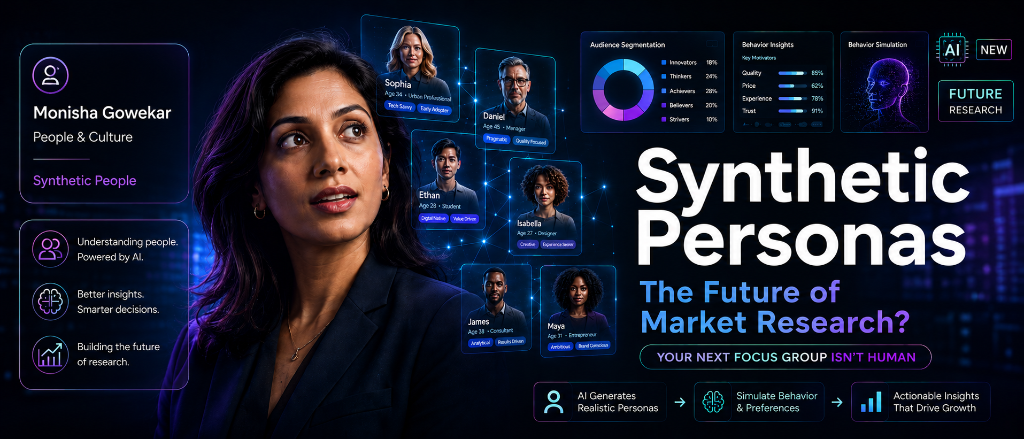


Synthetic consumer research is probably the most debated customer understanding technique of our times. For some, it promises unprecedented speed and scale. For others, it raises concerns about its reliability and authenticity. Many even question its very existence, asking: Is it even real?
If a Synthetic Persona is not real, are the results fake?
But instead of asking whether synthetic research can be trusted, we should rather ask, "What kind of architecture makes synthetic consumer research trustworthy?"
Before diving deep, we should understand that synthetic consumer research is not just about asking an LLM to pretend to be a consumer.
The Core Pipeline: How Synthetic Research Actually Works
Step 1: Data Ingestion
It begins with ingesting real human data—surveys, interviews, behavioural data, purchase history, customer feedback, and observations. Even the best chef can't create a great meal with poor ingredients. Likewise, even the most advanced synthetic research system can't produce trustworthy insights if it's built on poor-quality, incomplete, or biased data. But here's the real challenge: the ingredients themselves are often imperfect. We humans are wonderfully inconsistent. We claim we'll pay more for sustainability, say we'll exercise regularly, or express interest in a product during a survey, yet our real-world decisions often tell a different story. Synthetic research does not invent these contradictions; it inherits them. And if its architecture is not designed to account for the gap between stated preferences and actual behaviour, the insights may sound convincing while drifting away from reality.
Step 2: Profile Organization & Personas
Next, just as the chef decides how to combine the ingredients based on the dish they're making, models similarly organize profiles into synthetic personas, mirroring people's goals, motivations, habits, frustrations, and preferences.
Once you have the ingredients: that is, human data, the AI prepares the recipe. It begins by creating Synthetic Personas. Some firms even create Digital Twins in more advanced cases. These are virtual archetypes that can be surveyed, interviewed, or tested. But just as a chef can't improve stale ingredients by following a better recipe, models can't create reliable personas from unreliable human data. The quality of the output will always reflect the quality of what went in.
Step 3: Reasoning and Simulation
Now comes the reasoning and simulation part. The chef actually cooks, using their experience to predict how different flavours will work together. Similarly, the models simulate how a particular persona is likely to think, respond, and behave in a given situation. They then generate the most probable response based on the patterns they have learned.
Step 4: Continuous Validation & Litmus Testing
Just as a chef tastes the dish before serving it, synthetic research also needs a litmus test by comparing AI-generated insights with real-user data, checking for consistency, identifying bias, and validating whether the outputs hold up in the real world.
Step 5: Operational Insight Output
In synthetic research, the final output could be simulated interviews, survey responses, concept feedback, customer journeys, or product recommendations that help teams make decisions. Every layer of the architecture influences the quality of the final insight.
Why an Architecture of Trust is Paramount
But before trusting those insights, we need to ask ourselves: How are they created? Because trust doesn't come from AI models; it comes from understanding the architecture behind it. This is why an architecture of trust is paramount.
As synthetic research integrates into product development and business strategy, it's easy to be impressed by speed. But speed alone doesn't make insights trustworthy. Understanding the architecture helps researchers know when to trust the findings, when to validate them with real users, and when to challenge them. Clearly, better architecture leads to better decisions.
Synthetic research is not just about Artificial Intelligence generating answers. It is about the architecture that creates those answers. When the foundation is transparent, real-time, and built on quality human data, trust follows. We don't trust a bridge because it looks impressive; we trust it because of the engineering beneath it. Synthetic research is no different. Trust is built on architecture, not smart algorithms.
The Human Core of Artificial Intelligence
Perhaps the biggest misconception about synthetic research is that it begins with AI. It doesn't. It begins with people.
Every Synthetic Persona is rooted in human experiences. Every simulation is shaped by human data. Every insight ultimately traces back to human behaviour.
AI is simply the chef. Humans are, and always will be, the ingredients.