
So, what are Synthetic Personas?
Synthetic Personas are essentially digital versions of consumers created using AI and Large Language Models, designed to mirror real people's preferences and reactions so teams can test ideas before launch. In simpler terms: if a traditional persona is a photograph of your customer, a synthetic persona is a living simulation—one you can question, challenge, behaviorally intervene in, and evolve. They are born out of techniques like clustering, neural networks, and behavioral modeling.
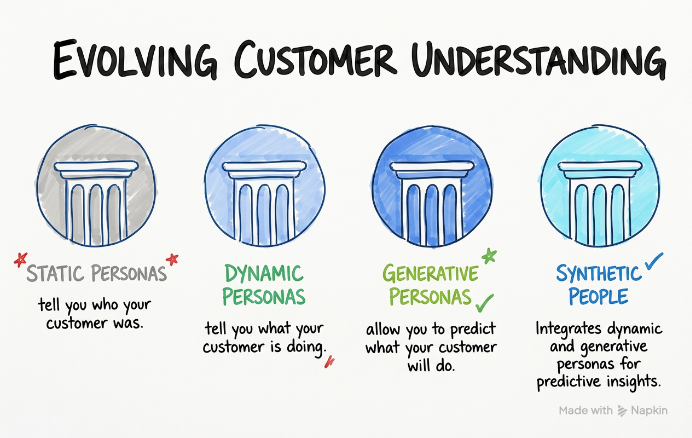
These models digest inputs from behavioral data, social listening, digital footprints, and predictive algorithms. By decoding deep behavioral patterns and hidden correlations, AI builds more than just a profile; it creates a "digital twin."
Wondering what a Digital Twin is?
Think of a digital twin as a virtual consumer that is always evolving in real-time, just as we humans are! It is built to reflect how a real person might respond to products, messaging, or decisions.
These models do not just reflect current characteristics; they act as a predictive sandbox, helping brands anticipate user actions before they even happen. This predictive power is exactly how you close the gap between what a customer claims in a survey and what they actually do at the checkout counter.
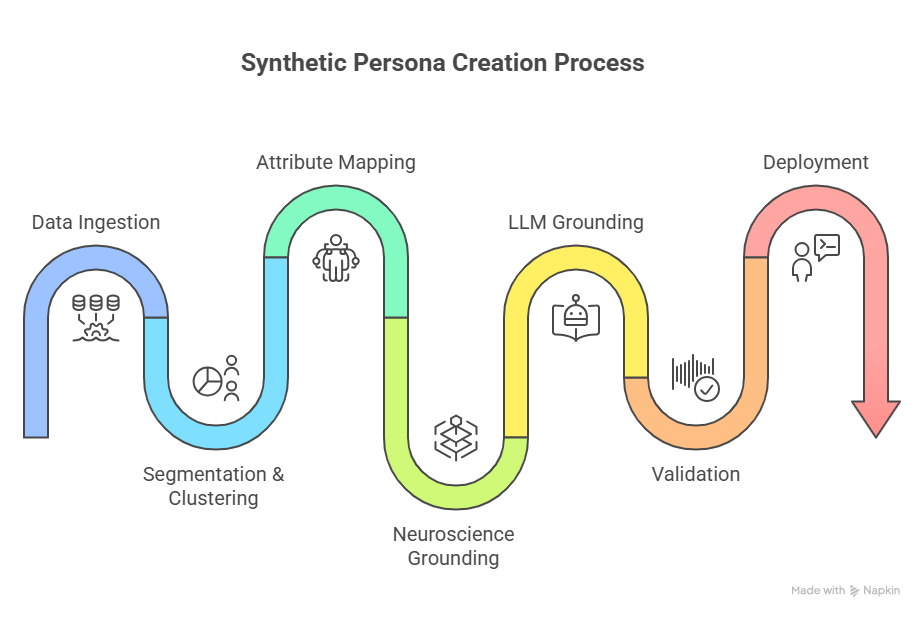
The Persona Evolution: From Paper Portraits to Living Simulations
In the world of insights, a synthetic persona can be our North Star. But just as we have moved from paper maps to real-time GPS, personas have evolved from flat, frozen descriptions into living, breathing digital twins.
1. Static Personas: The Passport Photo
Think of a Static Persona as a printed photograph. It captures a single moment in time based on historical survey data—but it is fundamentally stuck in the past.
- The Anatomy: A slide deck that introduces "Ben, the 30-year-old tech professional who loves artisanal coffee."
- The Flaw: People are fluid, but photos are fixed. A static persona cannot tell you how Ben feels about a market crash today or how his loyalty shifts during a 10% price hike. It is a one-way communication: you can observe him, but you cannot engage with him.
2. Dynamic Personas: The Live Weather Feed
A Dynamic Persona functions like a high-tech weather map. It is not just a snapshot; it is a profile that refreshes as new data flows in.
- The Anatomy: A data-driven profile synced with real-time market signals. If consumer sentiment in Bengaluru shifts overnight, the persona's "stats" shift with it.
- The Value: It solves the relevance problem. By moving with actual market behavior, it begins to bridge the "Say-Do" gap. However, while it tells you what is happening in the current climate, it often struggles to explain the deeper "why" behind a sudden change in direction.
3. Generative Personas: The Interactive Digital Twin
A Generative Persona is like a character in a sophisticated simulation—a living agent with a complex "behavioral brain." It does not just sit on a slide; it thinks, reacts, and interacts.
- The Anatomy: Built on Large Behavioral Models (LBMs), these personas allow for an active exchange. You do not just read about their preferences; you can question them.
- The Magic: This is where we move into the "Decide" phase. Because they are generative, you can stress-test "What if?" scenarios with them. For instance, "How would your core segment react if you pivoted to a subscription model?" Powered by a foundation of psychology and neuroscience signals, the persona simulates a response that mimics real-world decision making.
The Bottom Line:
An Obvious Question: Are Synthetic Personas Based on Real Life?
Indeed, yes! Real conversations will always be the heartbeat of empathy, but in a fast-moving market, they cannot be your only compass. Industry leaders are increasingly adopting synthetic personas to 'stress-test' initial ideas and UX workflows at lightning speed. By the time companies like Amazon or Google move to direct customer validation for a major launch, synthetic modeling has already filtered out the noise from the signal, ensuring that human conversations are focused on the most critical strategic nuances.
They are anchored in real-world behavioral data, survey responses, purchase patterns, social signals, and psychographic studies. These personas are a compressed, queryable version of real human reality. The more real data they are trained on, the more human they become.
What Are We Calling Them? Deciphering the Synthetic Jargon
The AI research space is moving fast, and as a result, different people use different words for similar ideas. Here is a quick guide to help you navigate the jargon.
The 5 Faces of "Synthetic" in Modern Research
The term "synthetic" is a broad one, but in the professional research space, it represents five distinct ways you can model human behavior. Understanding these differences is key to choosing the right tool for the right decision.
- Synthetic Personas (The Archetypes): They are AI representations of consumers that think or behave in similar ways. They are useful in the "ideation" phase, helping teams explore how a typical consumer might think, feel, or react to an idea.
- Simulated Conversations (The Interactive Interview): This is an active dialogue. It involves AI-powered, focus-group-style interactions where researchers can "interview" synthetic participants to uncover qualitative nuances in real-time.
- Digital Twins (The Living Models): A digital twin is a virtual copy of a real person that thinks, reacts, and updates just as the real human would. It is a living model that you can ask questions, test ideas on, and get answers from.
- Synthetic Consumers (The Decision Simulators): A synthetic consumer is an AI-generated persona who thinks, behaves, and—most importantly—decides like a real human, allowing you to test products before real consumers ever see them.
- Synthetic Respondents / Augmented Data (The Scale Enablers): Think of it like a weather forecast. A meteorologist does not wait for it to actually rain in every city before telling you it will rain. They use historical data like pressure, humidity, and wind to model what is likely to happen. Synthetic respondents do the same with human behavior. Their motto is: Start with what you have, build what you need, and see the whole picture.
Understanding the Functional Brain of a Synthetic Persona
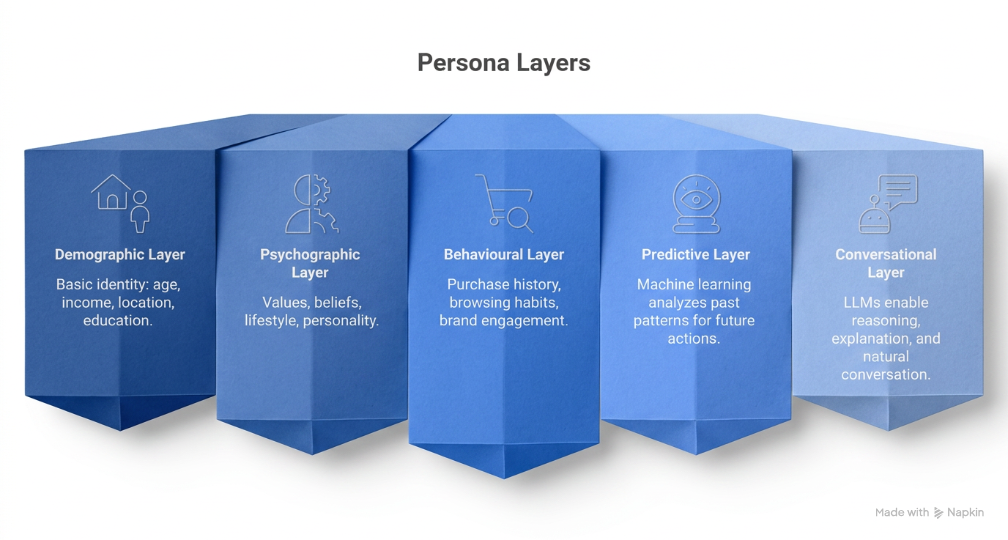
Case in Point
A global FMCG company was exploring sustainable packaging. In focus groups, consumers were overwhelmingly positive, saying they would happily pay more for eco-friendly materials. On paper, it looked like a clear winner.
But when the same consumers were modeled in real-world shopping conditions—balancing price, time pressure, and everyday distractions—the picture changed. Interest dropped sharply at checkout.
The key takeaway is that the same people responded differently in different contexts. Situation matters. Someone talking about sustainability in a focus group can genuinely mean it and still make a different choice in a busy supermarket aisle while comparing prices and juggling a hundred smaller decisions.
That insight changed the company’s rollout before launch.
The takeaway: It is not about synthetic systems being "more truthful" than people. It is about recognizing that behavior is situational, and context often matters more than what people say in the moment.
Where Synthetic Personas Are Headed
For decades, Market Research followed a repetitive cycle: recruit, survey/interview, analyze, report, and repeat. This worked when markets were slower, but now consumer behavior shifts rapidly. Evolving volatile markets, faster product cycles, and changing customer expectations require real-time adaptation. What worked in yesteryears does not work today.
To counter these persistent challenges, Synthetic Personas are being adopted by top companies around the world, steadily moving from a niche capability to a mainstream workflow. While synthetic data remains a topic of active discussion, it holds immense potential to redefine the marketing process and product development lifecycle. Importantly, these tools are meant for augmentation rather than replacing traditional market research.
Additionally, the statistics are in:
- Synthetic data could become a $2.34 billion industry by 2030, according to KANTAR.
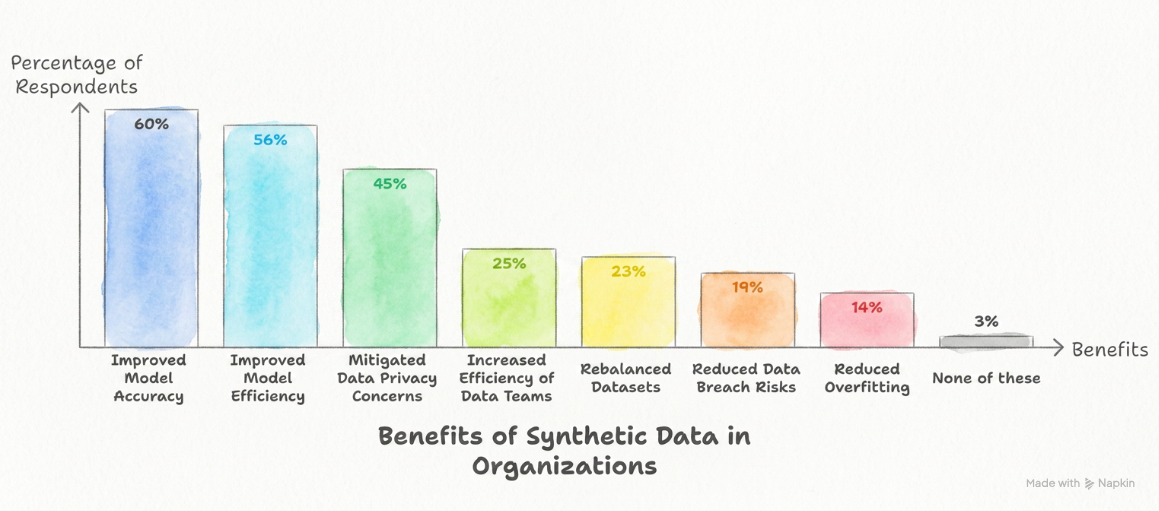
Source: Gartner Peer Community, Generative AI for Synthetic Data survey © 2023
Synthetic Research, when used thoughtfully, can be a powerful advantage for any brand. Ultimately, the value of AI insight depends on how thoughtfully humans guide it.
The real transformation happens when insights are faster and rooted in how people actually think and behave. That is exactly what we are building toward at Synthetic People.
To leave you with one final takeaway—have a look at our Test Lab, where you can explore real benchmarks and see the results firsthand: