

The Epistemology of Customer Understanding
For decades, traditional research has been treated as the gold standard of customer understanding. Surveys, focus groups, interviews, panels. Structured. Human. Methodical. And yet, frequently misaligned with real market outcomes. Now synthetic research is emerging as a new paradigm. Faster. Scalable. Simulated. Behaviour-driven. But the real debate is not about speed. It is about epistemology — how truth about customers is generated.
What Traditional Research Actually Captures
Traditional research captures articulated reality. It asks people: What did you like? Why did you choose this? Would you buy this? And people answer sincerely. But sincerity is not the same as behavioural accuracy. Because most human decisions are not made in reflective environments. They are made under time pressure, social context, emotional tension, incomplete information, and cognitive shortcuts. By the time research happens, the decision is already over. What remains is the explanation. Clean. Logical. Rational. And often reconstructed.
The Core Limitation: Post-Rationalised Insight
When respondents explain their behaviour, they are not lying. They are narrating. Memory compresses complexity. Emotion gets softened. Contradictions get smoothed into coherent stories. Traditional research therefore captures: What people believe they did. Not always what actually drove the decision. This is why stated preferences and real-world behaviour frequently diverge.
What Synthetic Research Actually Models
Synthetic research, when properly grounded, does not rely on recalled explanations. It models decision formation itself. Instead of asking: "What would you do?" It simulates: "How does a decision emerge under context, habit, emotion, and constraint?" This is a fundamentally different layer of insight. Not retrospective. Not purely declarative. But behavioural and contextual.
Speed Is Not the Real Disruption — Context Is
Many assume synthetic research is simply faster research. That is a shallow interpretation. The real shift is contextual depth at scale. Traditional research is limited by sample sizes, fieldwork timelines, respondent fatigue, and cost of iteration. Synthetic research removes these constraints, allowing unlimited probing, scenario testing, message iteration, and behavioural exploration — without resetting the research cycle every time a new question emerges.
Where Traditional Research Still Wins (And Why That Matters)
Despite its limitations, traditional research has one undeniable strength: Direct human input. It captures lived experience, nuance, and real voices. When executed rigorously, it provides rich qualitative depth and external validation. But it is slow to iterate, expensive to scale, vulnerable to social desirability bias, and heavily dependent on how questions are framed. Which means it is powerful for validation, but inefficient for continuous decision environments.
Where Synthetic Research Changes the Decision Loop
Modern organisations do not make one decision per quarter anymore. They make dozens per week: Pricing changes, Messaging shifts, feature prioritisation, campaign optimisation. Traditional research cannot keep up with this velocity without compromising cost or depth. Synthetic research enables continuous exploration, Pre-launch testing, Iterative hypothesis refinement, and Early signal detection before market exposure. This shifts research from a periodic function to an embedded intelligence layer.
The Cost of Slow Insight in Fast Markets
In high-velocity markets, the biggest risk is not incorrect research. It is delayed research. By the time traditional findings arrive: The product has shipped. The campaign has launched. The market has reacted. At that stage, research becomes diagnostic, not preventative. Synthetic research introduces a preventative intelligence layer — testing decisions before they become expensive realities.
How Synthetic People Approaches This Differently
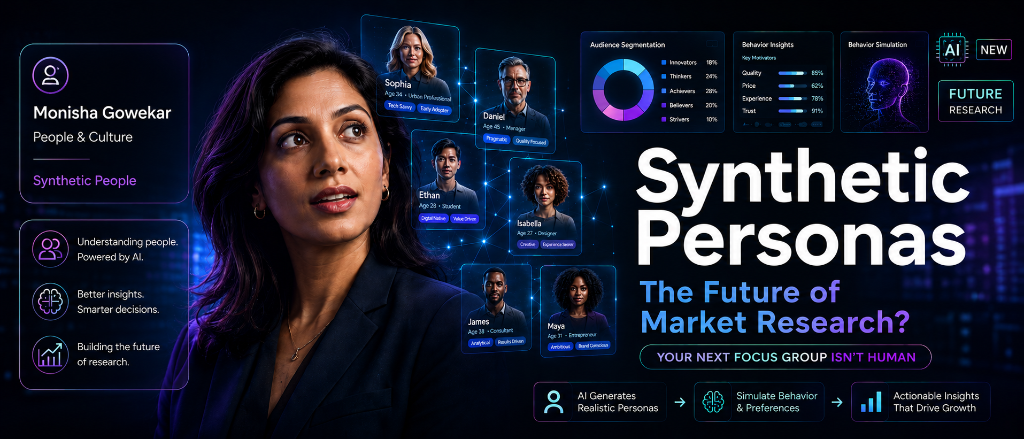
Synthetic People is not positioned as a replacement for human research. It is designed as a behavioural intelligence layer that operates before, between, and alongside traditional methods. Built on a Grounded Intelligence framework, it integrates real-world consumer action data, neuroscience-informed emotional signals, historical study calibration, and behaviour-focused modelling systems. This allows teams to explore reactions, objections, and latent behaviours before rationalisation reshapes the narrative.
The Future Is Continuous Understanding
The future of customer insight will not eliminate traditional research. It will reposition it. Human research will validate. Synthetic research will explore, iterate, and pressure-test continuously. Together, they form a more complete intelligence system. But on its own, episodic research in a continuous decision world is structurally insufficient.
Final Thought: What Actually Produces Better Decisions?
Not the method that sounds the most human. Not the method that is the fastest. But the method that stays closest to how real decisions form — messy, emotional, contextual, and constraint-driven. Because in the end, markets do not respond to what customers say in research settings. They respond to what customers do in real environments. And the closer your research gets to that moment of decision formation, the more defensible your strategy becomes.